



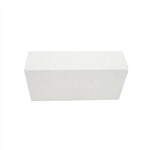



Erimiş Zirkonyum Korindon Tuğla
MOQ:5TONS

1. High Temperature Resistance: Due to its high content of alumina and zirconia, it has excellent resistance to high temperatures.
2. Corrosion Resistance: The product has good resistance to corrosion by acidic and alkaline substances.
3. Thermal Shock Resistance: Fused zirconium corundum brick has excellent thermal shock resistance, which means that it can withstand sudden temperature changes without cracking.
4. Good Mechanical Properties: It has great mechanical strength, compressive strength, abrasion resistance, and slag resistance.
5. Uniform Structure and Low Porosity: The product has a uniform structure, low porosity, and is resistant to alkali and slag erosion.
Fused zirconium corundum brick is produced using high-quality raw materials such as alumina and zirconia. These materials are mixed and smelted in an electric arc furnace under high temperature and pressure. The resulting material is then processed into the desired shape and size through a molding machine.
1. Raw Material Selection: High-quality raw materials such as alumina and zirconia are carefully selected.
2. Melting: The raw materials are melted in an electric arc furnace under high temperature and pressure.
3. Molding: The melted material is then molded into the desired shape and size using a molding machine.
4. Drying and Firing: The molded product is dried and fired in a kiln at high temperature.
5. Testing and Quality Control: The final product is tested for quality and then sent for packaging and shipping.
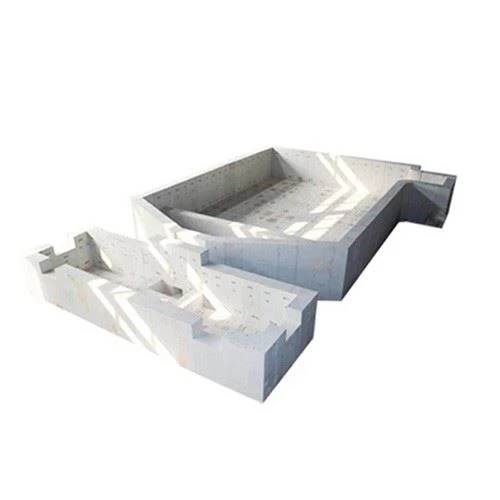
The compactness of Fused zirconium corundum brick may be relatively low, but it usually has good corrosion resistance and is suitable for some chemical industries and metallurgical fields. Because the fusion-casting process can produce bricks of large sizes and special shapes, it may be more suitable for certain applications.
①Irregular changes in thermal expansion. The expansion curve of fused zirconium corundum bricks has an abnormality near 1000 degree . The internal Zr02 crystal undergoes reversible crystal transformation and has a large volume change. Therefore, bricks containing ZrO2 should not be used at temperatures around 1000 degree . Parts that fluctuate sharply. When baking the kiln, the temperature change between 900 and 1150 degree should not be too large, generally not exceeding 15 degree /h, and a steady temperature rise is required. Some parts need to be protected from cold wind and need to be protected with other bricks to prevent explosion.
③ Eutectic melting. When fused cast zirconium corundum bricks and clay bricks are laid in contact with each other, eutectic phenomena will occur at a high temperature of 1300 degree . Therefore, when selecting refractory materials, avoid contact between two refractory materials with serious eutectic phenomena, such as silica bricks in Under the fused cast azs brick, it is most susceptible to erosion by the fused zirconium corundum brick.
Popüler Etiketler:
Bir çift
Silisyum Karbür TuğlalarSonraki
Erimiş Dökme AZS BloğuBunları da sevebilirsiniz



Soruşturma göndermek